
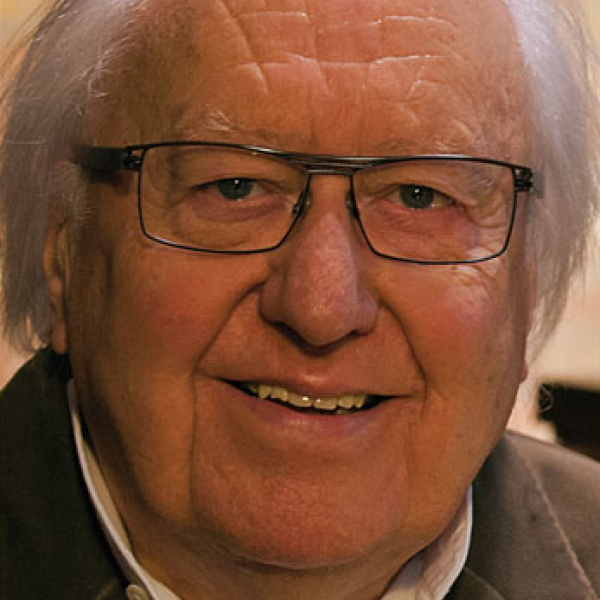
Dubois as a student
In 1952 Dubois (7/12/1934) began his organ education at the Lemmens Institute in Mechelen with Piet Vanden Broeck. He also took counterpoint from Marinus de Jong and harmony and fugue from Staf Nees. These two musicians were a source of inspiration for Dubois. After having been at the Lemmens Institute for your year, Dubois decided to relocate to Antwerp in 1955. Here he was able to take organ lessons from his role model Flor Peeters. He obtained several prizes for organ, music history, counterpoint and fugue. After an education of 6 years in Antwerp, Chris Dubois decided to study psychoacoustics and electronic music at the university of Ghent. These studies were in preparation of the exam musicus-modulator at BRT. He passed the exam, but was not hired.
A valued organist
In 1964 Dubois became laureate at the international organ competition in Bruges. As yet, he is the only Belgian laureate to come out of this competition. In 1967 he became the organ teacher at the Lemmens Institute of Leuven. Here he produced many organ students who would later make a name for themselves in the organ and music world: Peter Pieters, Luc Ponet, Bart Naessens, Peter Ledaine, Ignace Michiels… Dubois also lent his services as an organ teacher to the music academy of Roeselare. In 1980 he was engaged as the organ teacher at the Conservatory of Bruges.
Dubois also regularly performed abroad. He gave concerts in the United States, Canada, Italy and Germany. During a concert trip to Great Britain he was a soloist at King's College in Cambridge, and Pope John Paul II invited him to play at his home chapel in the Vatican as an honoured guest, as to musically enrich the service for the 150th birthday of the Papel-Belgian college.
Throughout all this, Dubois was on a continuous campaign for the recognition and spread of Flemish organ music. He played music by Flor Peeters, Jacques-Nicolas Lemmens, Herman Roelstraete, Edgar Tinel, Piet Swerts… He still finds it important to bring the youth into contact with the organ and incites excitement in them for the instrument. Up to today he is organist in residence for the monastery of the paters Karmelieten of Bruges where he participates in the weekly high mass in consultation with the Scola Gregoriana Brugensis under the direction of Roger Deruwe.
Hindemith as an inspiration
Chris Dubois already started composing at a young age. He mostly composed for organ, but also dabbled in a.o. carillon, piano and choir. Several of his compositions resulted in prizes. Among others he won the 1981 ‘Premie van de Provincie West-Vlaanderen’ for his 1970 composition The house by the leaning tree: Ode to Marnix Gijsen, a choral piece for four mixed voices a capella. When he composed this triptych, he was going through an experimental phase full of difficult passages and unexpected harmonies.
As he tells it himself, Dubois did not compose according to the traditional rules of music. He himself states that he does not pay much attention to all that is academic, and that it is his goal to infuse surprising elements into his compositions. The compositions by Paul Hindemith inspire him in his writing, the atmosphere and the build up of the musical material in particular.
Vlaams Magnificat
Chris Dubois is a diligent composer. Aside from his many compositions for organ, he also produced choral pieces such as two Flemish masses, christmas songs and a christmas suite, Regina Caeli, Salve Regina, Magnificat, Te Deum, Lord's Prayer, and several songs to writings by Guido Gezelle. He also reworked folk songs such as Ick zag Celcilia komen.
Chris Dubois wrote his Vlaams Magnificat in 1971. It was his first grand piece for choir. The foundation for this work can be found in Ignace de Sutter. Dubois was also inspired by the colors of Hugo Distler. Just like with The house by the leaning tree, Dubois composed his Vlaams Magnificat during his experimental phase. He composed it in such a way as to bring surprising elements to the forefront. In certain passages he introduces elements of the fugue, of which he does not follow the traditional rules. The Magnificat is not meant to be a Catholic piece. Chris Dubois said the following with regards to the first performance of the Vlaamse Magnificat: “When the composition was performed for the first time by the choir of the Lemmens Institute, the director at the time, Jozef Joris, looked at me askance”, because this composition was not written according to the traditional rules as people knew them.