
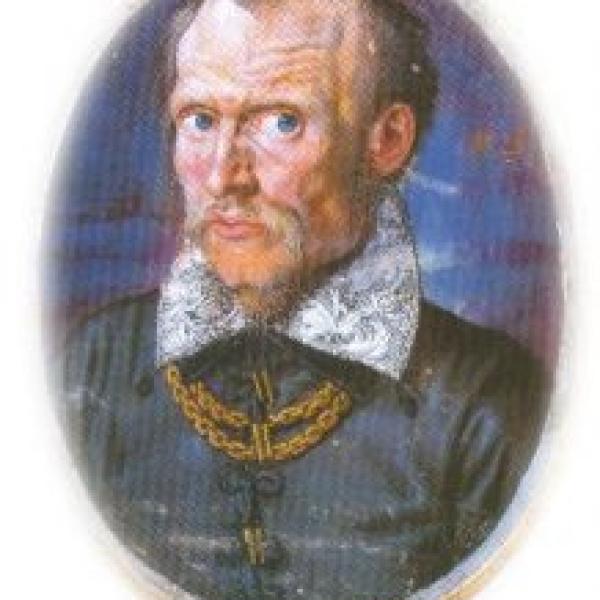
Cypriano De Rore, also known as Cipriano and Cyprien De Rore, was born in Ronse in 1515/16 and died in Parma at the end of September 1565. He was a representative of the fifth generation of the Franco-Flemish school of polyphonists.
Life
Not much is known about the musical education of Cypriano De Rore. It is possible that his education took place in Antwerp. It was long thought that he had studied under Adriaan Willaert in Venice and that he sang in the Basilica of San Marco, but there is not a lot to corroborate these assumptions. Even so, during a large part of his career he was narrowly connected to Willaert and his associates. In 1542 he was in Brescia, where he likely remained until 1546. It is in this period that he starts finding fame as a composer.
Around 1546 he entered the service of Duke Ercole II d’Este of Ferrara as a singing teacher. Giaches de Wert was one of his students. From 1560 to 1563 he was in the service of Margaret of Parma, governor of the Netherlands, in Brussels and her husband Duke Ottavio Farnese, in Parma. When his mentor Adriaan Willaert died in 1563, De Rore succeeded him as kapellmeister for the basilica of San Marco, but in 1564 he tendered his resignation and returned to Parma, where he died at the age of 49.
Composer
Cypriano De Rore was one of the most influential composers of the mid sixteenth century. He was a central representative in the generation of Franco-Flemish composers after Josquin Desprez who went to Italy to live and work. His experimental, chromatic and very expressive style had a decisive influence on the further development of the madrigal.
He wrote 107 madrigals, but he was also a productive composer of spiritual music, both masses and motets. Cypriano drew much inspiration from Josquin Desprez’ style and he developed many techniques taking the older composers’ style as a starting point.
We know of 5 masses, about 80 motets, several psalms, profane motets, and an arrangement of the st-John passion by his hand. The spirit of his composing tends to be serious.