
Education
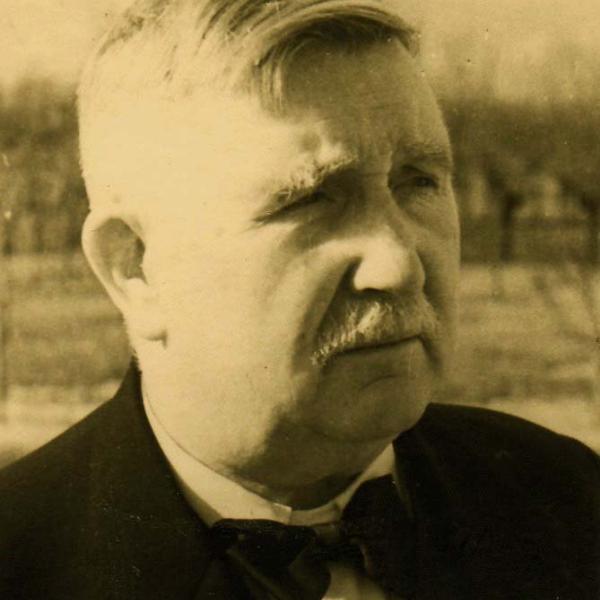
Lieven Seraphinus Duvosel (Ghent 14/12/1877 - Sint-Martens-Latem 20/04/1956) was a musical prodigy and already played in his father and stepmother's café chantant as a 7-year-old. From the age of 12 he took lessons at the conservatory of Ghent, where he became proficient in solfège, piano, harmony and counterpoint. In 1991 he wrote his first composition Le Crépuscule for piano. In 1992 he conducted his first cantata Hymne au Drapeau for tenor, male choir and orchestra. From then on he mainly composed Flemish choral music and as a student conducted many choral societies and harmonies. After his studies at the conservatories of Ghent and Antwerp he moved to Paris, where he studied at the conservatory between 1904 and 1908 with Widor (organ), Lenepveu (counterpoint) and Fauré (composition).
Composer and conductor
From 1908 to 1918, Lieven Duvosel acted as conductor of various music associations and music teacher at the city schools in Ghent. After the First World War (Duvosel had campaigned for the Flemishization of Ghent University), Duvosel spent three years in Berlin, where he had contacts with Richard Strauss and Arthur Nikisch who conducted some of his works (including the Berlin Philharmonic). Nikisch introduced him to the music publishing house Breitkopf & Härtel, which published several of his works.
From 1941 until his death in 1956 he lived back in Belgium. In addition to symphonic compositions, choral works and art songs, he also wrote a number of battle songs and choirs.
In total about 350 of his compositions have been preserved, mainly late romantic works, refined polyphonic, strong in counterpoint, impressionistic in color. Most of these are kept in the archives of the Royal Conservatory of Antwerp and can be consulted electronically and downloaded free of charge. Especially in his a cappella works for male voices, his flowing, singable melody lines come into their own beautifully.
Choral work (selection)
- Ave Maria for mixed choir and organ, SATB, manuscript
- Pater Noster for mixed choir and organ, SATB, manuscript
- Vier Vlaamse Volksliederen for mixed choir, SATB, manuscript (Heer Jezus heeft een hofke, Gloria in Excelsis Deo, Stille Nacht Heilige Nacht, Wilhelmus van Nassauwe.