
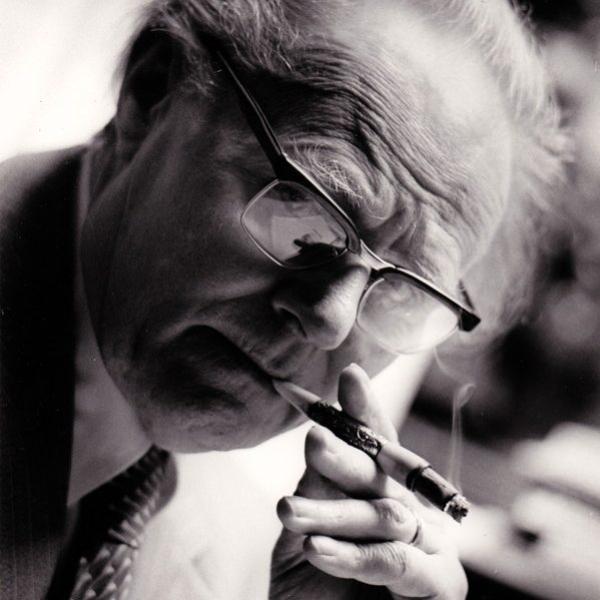
Life
Norbert Rosseau was born to an artistic family. His mother Stella Lussie, an accomplished pianist, and his father Maximilian, electrician, violinist, circus performer and musical clown, worked for a variety company which toured Italy. At a young age Norbert was taught violin by his father. When WWI broke out they stayed in Italy out of necessity. Here Rosseau received violin lessons from Armando di Piramo (first chair violinist for the Monte Carlo orchestra, later conductor of the renown gipsy orchestra and jazz pioneer.) Rousseau was 8 when he first performed. His general education consisted of homeschooling and self-education.
At the age of twelve he began studying composition as a private student of Giuseppe Mulè, who at that time was the principal of the Conservatory in Palermo. In 1925 Rosseau followed his teacher to Rome, where Mulè had become principal of the Conservatorio di Santa Cecilia. Rosseau started his studies on Italian literature and history of old music and then, still as a private student, took piano lessons from Renzo SIlvestri, organ lessons from Fernando Germani and fugue from Cesare Dobici. In 1929, Rousseau obtained his diploma for composition. In that same year he took completion courses from Ottorino Respighi and completed a conducting internship with the Philharmonic Orchestra of Rome, where he routinely performed as a soloist.
In 1932 Rousseau was called upon to fulfill his military service in Belgium and his family returned to Ghent. In 1940 he wounded his hand in action which ended his career as a concert violinist. From this point on he focused on composing.
Composer
Already before the outbreak of WWII he was at the forefront of experimenting with electronic composition and twelve-tone technique. When in 1963 the Institute for Psychoacoustics and Electronic Music was founded, he started taking lessons from Lucien Goethals.
Noberts Rousseau's opus consists of 121 works. From his portfolio a broad interest in style periods, composition styles, poetry and literature becomes apparent. He composed for soloists, choir and orchestra, chamber music, oratoria, song cycles, masses, passions, ballets, the opera Sicilienne and pieces with electronics and several pieces for smaller arrangements.
He was equally fascinated by the old church modi, the gregorian and the Greek monody as he was by electronic and Musique concrète. An example of the latter is his Electronische Mis (1967), which at its foundation uses recordings of boy voices, a crystal goblet, and dripping water droplets.