
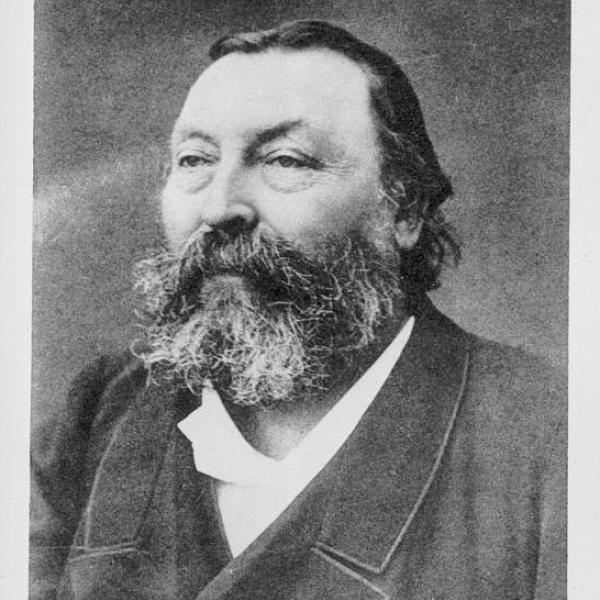
Biography
Benoit was born in Harelbeke, where his father (Petrus Benoit) directed the local wind band, church choir and church orchestra. As a consequence, Benoit’s preliminary musical education was taught by his father, after which he decided to study the piano and the organ with pianist-organist Pieter Carlier between 1847 and 1851.
Thanks to Pieter Carlier, Benoit eventually ended up in Brussels in 1949, where he got acquainted with François-Joseph Fétis. As the latter was the principal of the Royal Conservatory of Brussels, Benoit could start his education as a professional musician at this school only two years later. He studied counter point, fuga and composition with Fétis, while he also studied the piano with Jean-Baptiste Michelot and harmony with Charles Bosselet. When he graduated in 1854, he stayed a little longer in order to prepare himself for the biennially national ‘Prix de Rom’, which he won in 1857 with the composition ‘Le meurtre d’Abel’. This prize was a great financial support for his study tour in Germany, in order to complete his musical education in the most significant cities of the nineteenth century, such as Leipzig, Dresden, Berlin and München. With the same grant, he was able to settle in Paris between 1859 and 1863, where he directed the operette company Les Bouffes Parisiens by Jacques Offenbach.
Composer
During his time in Paris, Benoit was received well because of his engagement with the Flemish national traditions, which he used in his music innovatively. When he returned to Belgium in 1863, this early musical nationalism became more concrete in his oratoria Lucifer (1866) and De Schelde. These compositions were based on words by Emanuel Hiel, which enabled him to use the Flemish national language (Dutch) as the language of his compositions. Other works in which he focalizes Dutch and the Flemish national character are the compositions in which he celebrates national heroes, such as Rubenscantate (1877), Van Rijswijckcantate, Ledeganckcantate (1897) and De pacificatie van Gent (1876).